
No products in the cart.

An evergreen honeysuckle with glossy leaves and small fragrant winter flowers
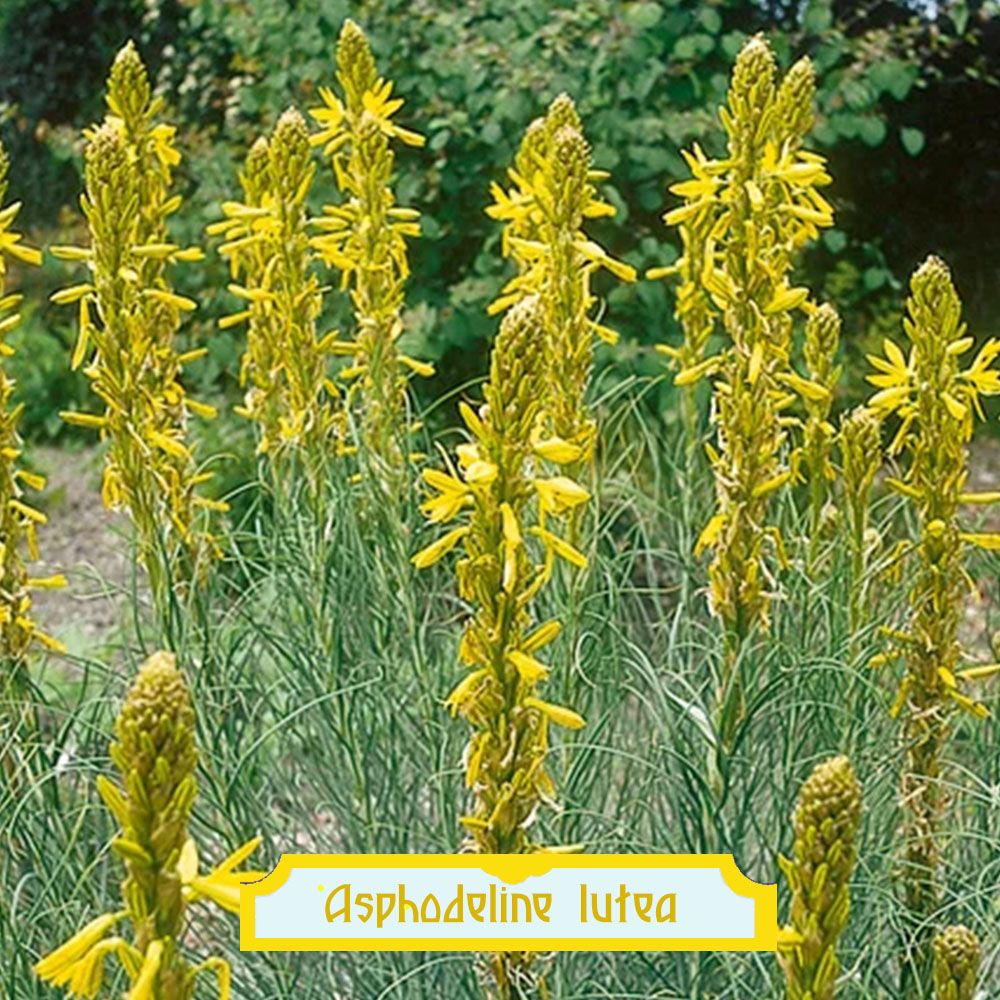
Asphodeline lutea is a perennial plant that produces tall flowering stems in spring, topped with large, star-shaped yellow flowers.
It grows in dense clumps, slowly spreading to form long, grass-like, bluish-green leaves.
The grass-like appearance of its foliage combines beautifully with broad-leaved or rounded plants in rock gardens and gravel gardens.
Learn more about gardening with Eleven O’Clock Ladies:
The genus Asphodeline is closely related to the ancient “asphodel” plants of Greek mythology.
In Greek tradition, asphodels were believed to grow in the Fields of Asphodel, a meadow in the underworld where ordinary souls wandered after death.
These fields symbolized peace, reflection, and eternal rest.
Because of this association, plants related to asphodel were often linked to remembrance, immortality, and the connection between life and the afterlife.
They were sometimes planted near graves or used in funerary rites in ancient Greece.
However, unlike the pale asphodels of myth, Asphodeline lutea stands out for its vibrant golden flowers.
Below you will find the most excellent tale of how it was introduced into the United Kingdom :
Asphodeline lutea was introduced into the University of Oxford Botanic Garden in 1648.
One of the curators of the garden at the time, John Parkinson, said the plant was “not… used in Physicke for any purpose.” (Physicke = of any medicinal or culinary use)
The locals in the Mediterranean who were interviewed by Parkinson said that that plant had “no… propertie appropriate unto it but knavery,” with no explanation of the particular knavery of which the plant was guilty. (Knavery = dishonest or unfair behaviour)
The description in the Botanic Garden used the old name of Asphodelus lutea
I cannot say that I have seen Asphodeline be dishonest… yet!
The flowers of Asphodeline lutea are arranged in upright, elongated racemes carried on sturdy, leafless stems. Each individual flower is star-shaped, composed of six bright yellow tepals that open widely when in bloom.
At the center of each flower are prominent orange stamens, which give the blooms a striking and luminous appearance. These stamens are slightly protruding and covered with fine hairs, enhancing their visual appeal and attracting pollinators such as bees and butterflies.
Flowering usually occurs from late spring to early summer, and the blossoms open progressively from the bottom to the top of the inflorescence, ensuring a long flowering period. After blooming, the plant produces small, rounded seed capsules containing dark seeds.
Asphodeline lutea is native to the eastern Mediterranean region, where it naturally grows in dry, open landscapes such as rocky hillsides, limestone slopes, scrublands, and semi-arid grasslands.
It thrives in environments with strong sunlight, limited rainfall, and well-drained, mineral-rich soils.
This plant is highly adapted to drought conditions.
Its deep root system allows it to access water stored in lower soil layers, while its narrow, grass-like leaves reduce water loss through evaporation.
In its natural habitat, Asphodeline lutea often grows alongside other drought-tolerant species such as thyme, lavender, cistus, and various grasses, forming resilient plant communities adapted to Mediterranean climates.
Jacob’s Staff
Southeastern Europe, northern Africa, the Caucasus and the Levant
Subscribe to get the latest posts sent to your email.
| Weight | 0,5 kg |
|---|---|
| Planting Season | February to March, September to November |
| Flower Color | 🟡 Yellow |
| Flowering | April, May |
| Foliage | Deciduous |
| Exposure | Full Sun |
| Frost Tolerance | -10°C to -15°C |
| Soil | Dry, Poor, Sandy, Well-Draining |
| Size | 0.8m H x 0.4m W |
Only logged in customers who have purchased this product may leave a review.


A large bulb loved for its garlic flavoured leaves
A large bulb loved for its garlic flavoured leaves


Beautiful showers of yellow flowers
Beautiful showers of yellow flowers


A sweet smelling ground cover, producing little blue flowers all summer long.
A sweet smelling ground cover, producing little blue flowers all summer long.


A daisy-like carpet of flowers
A daisy-like carpet of flowers


White pompom flowers to attract bees to your garden all summer long.
White pompom flowers to attract bees to your garden all summer long.


A spicy mint, known for its use in the production of liqueurs and herbal teas.
A spicy mint, known for its use in the production of liqueurs and herbal teas.


A native perennial with blue-green leaves and a tall yellow flower
A native perennial with blue-green leaves and a tall yellow flower


A wooly white perennial plant from the Mediterranean region.
A wooly white perennial plant from the Mediterranean region.


A sweet smelling culinary herb from Europe
A sweet smelling culinary herb from Europe


A highly fragrant, grey-green bush.
A highly fragrant, grey-green bush.


Striking green and yellow variegated foliage.
Striking green and yellow variegated foliage.


Gorgeous blushes of pink and white that appear in the coldest nights.
Gorgeous blushes of pink and white that appear in the coldest nights.


A grey-green spreading ground cover from the mountains.
A grey-green spreading ground cover from the mountains.


A bromeliad featuring a three colored, striped flower
A bromeliad featuring a three colored, striped flower


A dwarf perennial known for its vermillion colored flowers
A dwarf perennial known for its vermillion colored flowers


A shrublet composed of soft, finely divided silvery gray-white leaves.
A shrublet composed of soft, finely divided silvery gray-white leaves.


Looping elegance and ability to form a low flowering ground cover
Looping elegance and ability to form a low flowering ground cover


Known for its draping form of silver-gray foliage and radiant blooms.
Known for its draping form of silver-gray foliage and radiant blooms.


An elegant blue, low-maintenance perennial ground cover.
An elegant blue, low-maintenance perennial ground cover.

A perennial with bright daisy-like flowers, known for flavoring teas and syrups.
A perennial with bright daisy-like flowers, known for flavoring teas and syrups.


A dense cushion of golden leaves that transition to a light green hue in summer
A dense cushion of golden leaves that transition to a light green hue in summer

A pink and white striped carpet of flowers
A pink and white striped carpet of flowers
There are no reviews yet.