
No products in the cart.
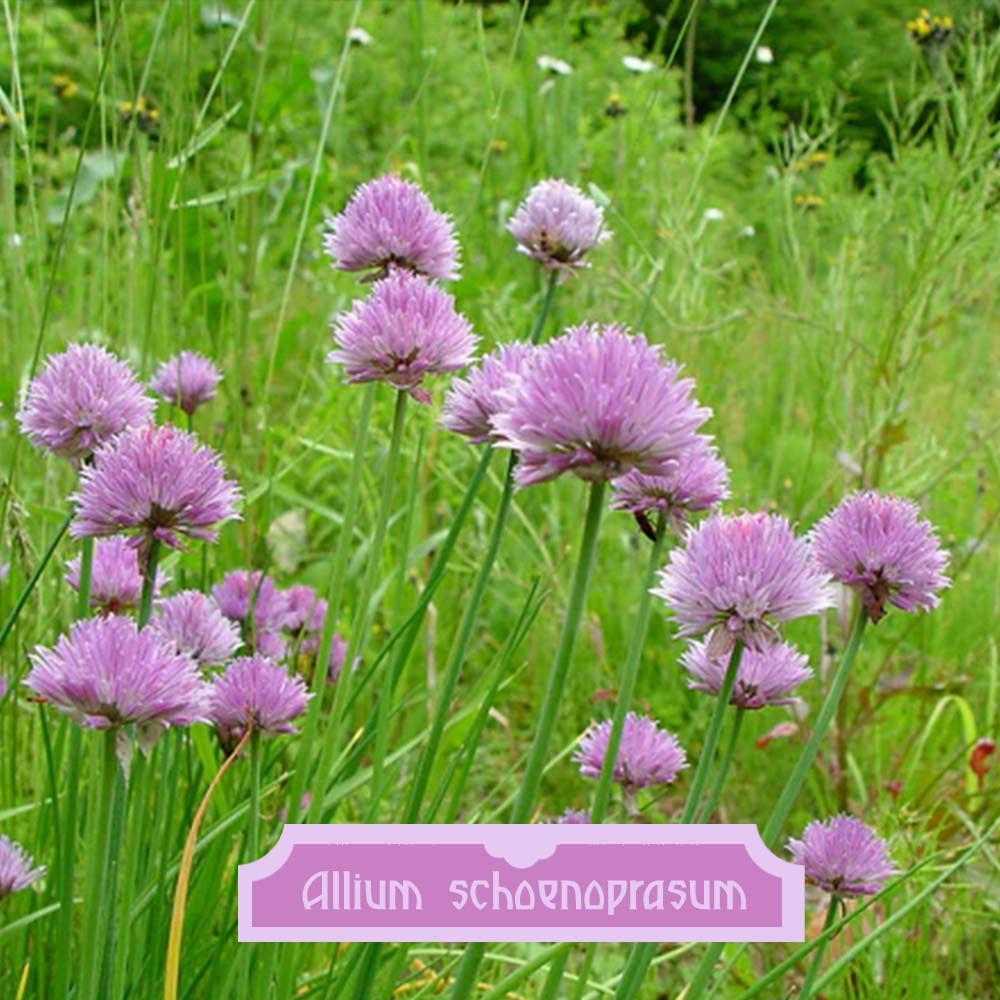

Allium schoenoprasum est une plante vivace aromatique et culinaire, recherchée pour sa résilience et ses usages ornementaux.
Les bulbes produisent de feuilles fines et tubulaires bleu-vert, au goût et à l’arôme délicat d’oignon, appréciées tant pour la cuisine que pour leur intérêt décoratif.
De la fin du printemps au début de l’été, la ciboulette développe des tiges dressées, sans feuilles, surmontées de ombelles parfaitement rondes de fleurs étoilées allant du mauve clair au violet.
Ces fleurs s’élèvent au-dessus du feuillage comme de petits feux d’artifice, apportant structure et couleur aux jardins d’herbes aromatiques et aux bordures.
Les feuilles dégagent une légère odeur d’ail lorsqu’on les écrase.
La ciboulette pousse en touffes denses formées par de petits bulbes allongés.
Il est à la fois rustique et tolérant à la sécheresse en été.
Il est idéal pour les jardins sauvages ou le xérophytisme, comme bordure basse par exemple, mais il est également magnifique (et délicieux) en pot en milieu urbain.
👨🌾CONSEILS DE JARDINAGE👨🌾: Allium schoenoprasum
-
- La ciboulette à l’ail prospère en plein soleil à mi-ombre et préfère un sol fertile et bien drainé, bien qu’elle tolère diverses conditions.
- La plante est résistante au gel et rustique dans les zones USDA 4 à 9.
- Arrosez modérément ; gardez le sol constamment humide mais évitez l’engorgement.
- Entretien : Diviser les touffes tous les quelques années pour maintenir la vigueur et éviter la surpopulation
- Son port dressé et touffu la rend adaptée aux bordures, aux contenants et aux jardins d’herbes aromatiques - à planter avec Artemisia camphorata, Carex buchananii, Geum coccineum ‘Carlkaer’
Ressources pour en savoir plus sur la cuisine avec la ciboulette :
👨🌾CONSEILS CULINAIRES👨🌾
-
- Les feuilles, tiges et boutons floraux sont tous comestibles.
- Apporte un goût léger d’oignon aux omelettes, poissons, pommes de terre, soupes et tartines au fromage frais.
- Ajoutez les fleurs comme garniture comestible !
- Une récolte régulière des feuilles encourage une nouvelle croissance et prolonge la productivité.
Ressources pour en savoir plus sur la cuisine avec la ciboulette :
Les Contes et La Botanique : Allium schoenoprasum
La ciboulette est la seule espèce d’Allium native à la fois du Nouveau et de l’Ancien Monde.
Allium schoenoprasum, communément appelé chives ou ciboulette, est une plante vivace herbacée de la famille des Amaryllidaceae, proche des oignons, de l’ail et des poireaux.
Le genre Allium est ancien et répandu, son nom dérivé du latin et associé depuis l’antiquité aux bulbes comestibles et odorants.
Le nom d’espèce schoenoprasum vient des racines grecques — σχοίνος, skhoínos (roseau ou jonc) et πράσον, práson (poireau) — signifiant « poireau de roseau », en référence aux feuilles fines et creuses de la plante.
Son nom anglais, chives, dérive du mot français cive, issu de cepa, le mot latin pour oignon.
Les Roms ont utilisé la ciboulette dans la divination — ils suspendaient des bottes de ciboulette séchée autour d’une maison pour éloigner maladies et maléfices.
Mon conte préféré sur la ciboulette est qu’au XIXᵉ siècle, des fermiers hollandais nourrissaient leur bétail avec l’herbe pour donner un goût différent à leur lait. Aujourd’hui, ce goût d’oignon sauvage est considéré comme désagréable et est jeté. Difficile à imaginer pourquoi…
Mythes et Traditions
La ciboulette a été cultivée pendant des milliers d’années en Europe et en Asie, appréciée autant pour son symbolisme protecteur que pour sa saveur. Dans le folklore, des bottes de ciboulette étaient suspendues dans les maisons pour éloigner maladies et mauvais esprits, et plantées près des habitations pour repousser les nuisibles.
Au Moyen Âge, Allium schoenoprasum était considéré comme une herbe fortifiante, censée soutenir la digestion et la vitalité. Sa nature douce la distinguait des autres alliums plus forts, la rendant adaptée à un usage quotidien.
Aujourd’hui, la ciboulette incarne une double nature silencieuse : à la fois ornementale et comestible, humble mais essentielle, reliant facilement le monde de la cuisine à celui du jardin.
Morphologie florale
L’inflorescence d’Allium schoenoprasum est une ombelle compacte et sphérique, généralement de 3 à 5 cm de diamètre, composée de dizaines de petites fleurs à six pétales.
Chaque fleur présente six tépales violet-rose, six étamines dépassantes avec des anthères pâles et un ovaire central. Les fleurs s’ouvrent séquentiellement, prolongeant la période de floraison sur plusieurs semaines.
Riches en nectar et pollen, les fleurs de ciboulette attirent fortement les abeilles, papillons et autres insectes bénéfiques. Les fleurs sont également comestibles, avec un léger goût d’oignon et un intérêt décoratif dans les salades et garnitures.
Après la floraison, la plante produit de petites graines noires contenues dans des capsules papier, bien que la propagation se fasse le plus souvent par division.
Ecologie
À l’état sauvage, Allium schoenoprasum se trouve dans de vastes régions d’Europe, d’Asie et d’Amérique du Nord, sur les prairies humides, berges et lisières de bois ouverts.
Elle préfère le plein soleil à la mi-ombre et prospère dans des sols humides et bien drainés, tout en tolérant une large gamme de conditions et les climats froids. Exceptionnellement rustique, la ciboulette survit aux hivers rigoureux en se retirant dans ses bulbes, repoussant vigoureusement au printemps.
Dans les écosystèmes de jardin, la ciboulette joue un rôle écologique important. Ses fleurs nourrissent les pollinisateurs, tandis que son feuillage aromatique est censé repousser certains nuisibles, ce qui en fait une plante compagne précieuse dans les plantations mixtes.
Résiliente, généreuse et discrètement belle, Allium schoenoprasum reste l’une des plantes les plus durables et appréciées tant pour le jardin ornemental que comestible. Allium schoenoprasum remains one of the most enduring and beloved plants of both the ornamental and edible garden.
Biologie reproductive: Allium schoenoprasum
La plante se reproduit par graines et par division végétative.
Les graines germent au printemps, tandis que la division assure un enracinement rapide et préserve les caractéristiques désirées des cultivars.
La floraison intervient généralement la deuxième ou troisième année, offrant à la fois un attrait esthétique et une source de nourriture pour les pollinisateurs.
Autres Noms
Ciboulette
Origine
Europe, Asie, et Amerique du Nord
En savoir plus sur plant d'Avenir
Abonnez-vous pour recevoir les derniers articles directement dans votre boîte mail.
| Poids | 0,5 kg |
|---|---|
| Saison de Plantation | Mars à Mai, Septembre à Novembre |
| Couleur des Fleurs | 🩷 Rose |
| Floraison | Mai, Juin, Juillet, Août, Septembre |
| Feuillage | Caduc |
| Exposition | ☀️ Plein soleil |
| Rusticité | -20°C to -25°C |
| Sol | Frais, Humide, Bien Drainant |
| Taille | 0.3m H x 0.3m L |
Commentaires
Seuls les utilisateurs connectés les clients qui ont acheté ce produit peuvent laisser un avis.
Vous pourriez également aimer…


Allium ampeloprasum var. ampeloprasum
Un bulbe connu pour ses feuilles au goût d'ail
Un bulbe connu pour ses feuilles au goût d'ail
4,90 €


Geum hybrid coccineum “Carlskaer”
Loved for its neon yellow petals and orange-yellow stamens
Loved for its neon yellow petals and orange-yellow stamens
4,90 €


Allium senescens subsp. montanum
Ail des montagnes aux fleurs en pompons roses
Ail des montagnes aux fleurs en pompons roses
4,90 €
Autres Produits


Vinca minor
Looping elegance and ability to form a low flowering ground cover
Looping elegance and ability to form a low flowering ground cover
4,90 €


Hieracium maculatum Leopard
Une plante vivace originaire avec des feuilles bleu-vert et une grande fleur jaune.
Une plante vivace originaire avec des feuilles bleu-vert et une grande fleur jaune.
3,00 €


Euphorbia cyparissias Clarice Howard
Une Euphorbia qui ressemble à un doux petit cyprès
Une Euphorbia qui ressemble à un doux petit cyprès
4,90 €


Satureja montana
Une herbe culinaire au parfum doux originaire d'Europe
Une herbe culinaire au parfum doux originaire d'Europe
4,90 €


Jacobaea maritima
Une plante vivace blanchâtre et velue originaire de la région méditerranéenne.
Une plante vivace blanchâtre et velue originaire de la région méditerranéenne.
4,90 €


Trachelospermum asiaticum ‘Ogon Nishiki’
Jasmine with colorful foliage and lovely white flowers in summer
Jasmine with colorful foliage and lovely white flowers in summer
4,90 €


Artemisia vulgaris Oriental LimeLight
Une Artemisia aux feuillage panaché vert et jaune vif
Une Artemisia aux feuillage panaché vert et jaune vif
4,90 €


Delosperma cooperi
Une vivace naine connue pour ses fleurs de couleur vermillon.
Une vivace naine connue pour ses fleurs de couleur vermillon.
4,90 €


Euphorbia myrsinites
Connue pour sa forme retombante de feuillage gris argenté et ses fleurs éclatantes.
Connue pour sa forme retombante de feuillage gris argenté et ses fleurs éclatantes.
4,90 €


Glechoma hederacea
Un couvre-sol au parfum doux, produisant de petites fleurs bleues tout au long de l'été.
Un couvre-sol au parfum doux, produisant de petites fleurs bleues tout au long de l'été.
4,00 €


Tradescantia Blushing Bride
Magnifiques touches de rose et de blanc qui apparaissent lors des nuits les plus froides
Magnifiques touches de rose et de blanc qui apparaissent lors des nuits les plus froides
Plage de prix : 4,00 € à 8,00 €


Tanacetum densum subsp amani
Un petit arbuste composé de feuilles douces et finement divisées de couleur gris argenté-blanc.
Un petit arbuste composé de feuilles douces et finement divisées de couleur gris argenté-blanc.
Plage de prix : 4,90 € à 12,00 €

Koeleria glauca Blue Sprite
Une graminée ornementale naine au feuillage bleuté
Une graminée ornementale naine au feuillage bleuté
Plage de prix : 4,90 € à 12,00 €


Artemisia Valerie Finnis
Une variation de l'Artemisia semi-persistante et aromatique
Une variation de l'Artemisia semi-persistante et aromatique
Plage de prix : 4,00 € à 12,00 €


Mentha x piperita ‘Chartreuse’
Un menthe épicée, connue pour son utilisation dans la production de liqueurs et de tisanes.
Un menthe épicée, connue pour son utilisation dans la production de liqueurs et de tisanes.
4,90 €


Erigeron kavinskianus
Un tapis de fleurs en forme de marguerites.
Un tapis de fleurs en forme de marguerites.
Plage de prix : 4,90 € à 8,00 €


Melissa officinalis
Une aromatique adorée par les abeilles, les familles royales et les amateurs de thé.
Une aromatique adorée par les abeilles, les familles royales et les amateurs de thé.
3,00 €
Vu récemment


Persicaria microcephala ‘Red Dragon’
Un feuillage violet profond, des tiges rouges vives et des fleurs blanches
Un feuillage violet profond, des tiges rouges vives et des fleurs blanches
4,90 €


Oscularia deltoides
A grey blue toothy succulent that forms a small, clumping bush.
A grey blue toothy succulent that forms a small, clumping bush.
6,00 €


Jasminum nudiflorum
Jasmin d’hiver – petites fleurs jaunes pour les sombres journées d’hiver
Jasmin d’hiver – petites fleurs jaunes pour les sombres journées d’hiver
6,90 €


Verbena bonariensis
De longues tiges avec de légères taches violettes flottantes qui attirent les abeilles.
De longues tiges avec de légères taches violettes flottantes qui attirent les abeilles.
Plage de prix : 4,90 € à 12,00 €


Sedum rupestre Angelina
Un couvre-sol vivace très coloré et facile d’entretien.
Un couvre-sol vivace très coloré et facile d’entretien.
4,90 €
Il n'y a pas encore de reviews.