


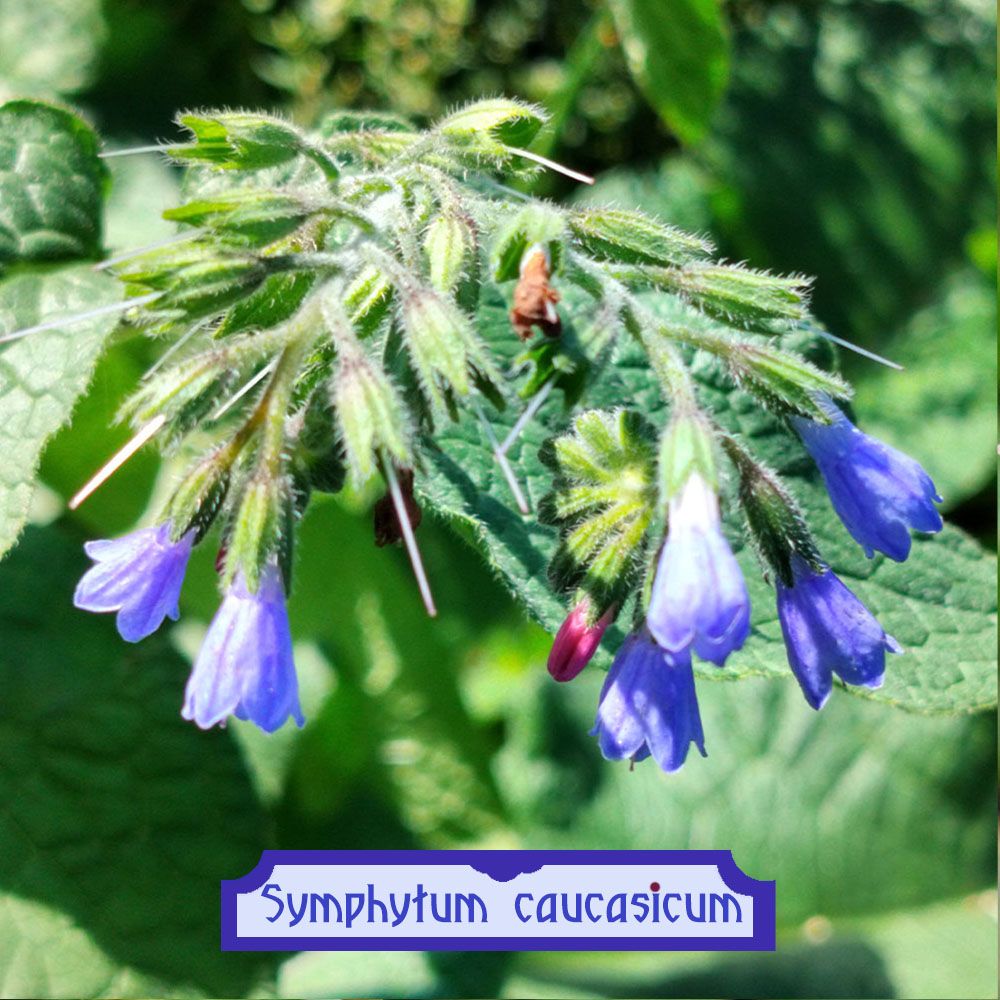
Symphytum caucasicum, Caucasian comfrey, is a robust and ornamental perennial with electric blue flowers, ideal as groundcover in shaded or naturalistic gardens.
The flowers are bell shaped, cream-colored with a blue tip, lifted high up on arching stems.
The leaves are great and somewhat coarse, covered in fine hairs that allow this plant to be both hardy and drought tolerant.
👩🌾 GARDENING TIPS👩🌾: Symphytum caucasicum
-
- Comfrey is often used as a ground cover or for naturalizing areas in gardens due to its ability to spread and form dense foliage. And when we say dense – we mean basically impenetrable. So if you have trouble with weeds, Miss Comfrey will sort that out in a summer breeze.
- Very powerful grower even in the shade
- Deadheading after flowering can help maintain its appearance and prevent excessive spreading. If needed, it can be cut back to control its growth.
- As with all comfrey varieties, this one has the potential to be invasive – so make sure you are ready to tame her with fencing or rocks.
- Looks great with Achillea Coronation Gold, Aster Monte Cassino
Learn more about gardening with comfrey:
The Tale & The Botany : Symphytum caucasicum
The origin of the names comes from:
symphuo (Greek) = “to grow together” or “to unite,” referring to the plant’s historical use in binding broken bones ( its common name “comfrey” in English comes from the Latin confervere to ‘heal’ or literally to ‘boil together’ 🫨)
caucasicum = hailing from the Caucasus
Ecology
Native to the mountainous regions of the Caucasus, Symphytum caucasicum thrives in moist, fertile soils, in shade or partial shade.
Its large, hairy leaves help retain soil moisture and protect the ground, while its flowers provide nectar and pollen for bees and other pollinators, supporting garden biodiversity.
Reproduction
The plant reproduces vegetatively via rhizomes, quickly forming dense clumps. It also produces seeds following insect pollination.
This dual strategy ensures long-term persistence and stable growth in the garden.
Floral Morphology
Its flowers are bright blue tubular bells, grouped in terminal clusters.
Each flower has five fused petals forming a tubular corolla, with exposed stamens and a central pistil, making it accessible to pollinators.
This elegant yet simple floral structure adds ornamental charm and ecological value.
Now comfrey has SO MANY interesting properties, beyond being generally stunning – are you ready?
Alright here we go now..
Comfrey = The Compost Activator
Comfrey is often called a “compost activator” thanks to its exceptional nutrient profile and rapid breakdown.
Its leaves are rich in potassium, nitrogen, calcium, and trace minerals, which are released quickly as the plant material decomposes.
When layered into a compost heap, fresh comfrey leaves act like a natural accelerator, stimulating microbial activity and helping slower materials break down more efficiently.
This results in a faster, hotter composting process and a richer finished compost.
Comfrey = Mulch
Used as a mulch, comfrey offers a slow-release source of nutrients while protecting the soil surface.
Chopped leaves can be spread directly around plants, where they suppress weeds, retain moisture, and gradually decompose into the topsoil.
Because comfrey breaks down rapidly, it doesn’t form a thick, suffocating mat like straw or wood chips.
Instead, it feeds soil life while keeping roots cool and hydrated — an ideal combination for vegetable beds and perennial plantings alike.
If you are looking to bring minerals and life back to poor soil > comfrey is a very good place to start.
Comfrey = Reduces Transplant Shock
Comfrey can be a valuable ally when transplanting young plants.
A small amount of chopped comfrey leaf added to the planting hole provides an immediate boost of nutrients just as roots begin to establish.
Its high potassium content supports root development and stress resistance, helping plants recover more quickly from transplant shock.
Gardeners have long used this technique as a gentle, organic way to encourage strong early growth without relying on synthetic fertilizers.
Comfrey = Bio-Fertiliser
When soaked in water, comfrey leaves produce a potent liquid feed often called “comfrey tea.”
As the leaves ferment, they release soluble nutrients — particularly potassium — into the water, creating a dark, nutrient-rich bio-fertiliser.
Diluted and applied to the soil or as a foliar spray, this natural tonic supports flowering, fruiting, and overall plant health.
It’s a simple, zero-waste way to turn garden biomass into a powerful, home-made fertiliser.
Other names
Comfrey
Origin:
Caucasus
Discover more from plant d'Avenir
Subscribe to get the latest posts sent to your email.
| Weight | 0,5 kg |
|---|---|
| Flower Color | 🔵 Blue |
| Flowering | June, July, August |
| Soil | Any, Cool, Moist |
| Exposure | Full Sun, Half Sun/Half Shade, Full Shade |
| Frost Tolerance | -25°C to -30°C |
| Size | 0.6m H x 0.6m W |
Reviews
Only logged in customers who have purchased this product may leave a review.
You may also like…

Aster pringlei ‘Monte Cassino’
Exquisite clouds of delicate white flowers.
Exquisite clouds of delicate white flowers.
3,90 €


Achillea filipendulina Coronation Gold
A tall flowering perennial known for its bright yellow flowers and long flowering season.
A tall flowering perennial known for its bright yellow flowers and long flowering season.
4,90 €
Related Products


Tanacetum densum subsp amani
A shrublet composed of soft, finely divided silvery gray-white leaves.
A shrublet composed of soft, finely divided silvery gray-white leaves.
Price range: 4,90 € through 12,00 €


Artemisia Valerie Finnis
A semi-evergreen, aromatic variation on the theme of Artemisia.
A semi-evergreen, aromatic variation on the theme of Artemisia.
Price range: 4,00 € through 12,00 €


Trachelospermum asiaticum ‘Ogon Nishiki’
Jasmine with colorful foliage and lovely white flowers in summer
Jasmine with colorful foliage and lovely white flowers in summer
4,90 €


Cerastium tomentosum var. columnae
A grey-green spreading ground cover from the mountains.
A grey-green spreading ground cover from the mountains.
4,00 €


Glechoma hederacea
A sweet smelling ground cover, producing little blue flowers all summer long.
A sweet smelling ground cover, producing little blue flowers all summer long.
4,00 €


Potentilla anserina
A distinctly silvery, silky and lacy perennial.
A distinctly silvery, silky and lacy perennial.
4,90 €


Mentha x piperita ‘Chartreuse’
A spicy mint, known for its use in the production of liqueurs and herbal teas.
A spicy mint, known for its use in the production of liqueurs and herbal teas.
4,90 €


Erigeron kavinskianus
A daisy-like carpet of flowers
A daisy-like carpet of flowers
Price range: 4,90 € through 8,00 €


Tradescantia Blushing Bride
Gorgeous blushes of pink and white that appear in the coldest nights.
Gorgeous blushes of pink and white that appear in the coldest nights.
Price range: 4,00 € through 8,00 €


Delosperma cooperi
A dwarf perennial known for its vermillion colored flowers
A dwarf perennial known for its vermillion colored flowers
4,90 €


Melissa officinalis
A perennial plant in the mint family that is adored by bees, royal families and tea drinkers.
A perennial plant in the mint family that is adored by bees, royal families and tea drinkers.
3,00 €


Vinca minor
Looping elegance and ability to form a low flowering ground cover
Looping elegance and ability to form a low flowering ground cover
4,90 €


Stachys byzantina
Silky white-grey leaves and tall striking flowers
Silky white-grey leaves and tall striking flowers
4,00 €


Hieracium maculatum Leopard
A native perennial with blue-green leaves and a tall yellow flower
A native perennial with blue-green leaves and a tall yellow flower
3,00 €


Hellebore argutifolius
Winter flowering perennial with marbled blue-green leaves
Winter flowering perennial with marbled blue-green leaves
4,90 €


Euphorbia myrsinites
Known for its draping form of silver-gray foliage and radiant blooms.
Known for its draping form of silver-gray foliage and radiant blooms.
4,90 €


Euphorbia cyparissias Clarice Howard
A Euphorbia that resembles a soft little cyprus tree
A Euphorbia that resembles a soft little cyprus tree
4,90 €
recent view product

Aster ageratoides Ashvi
A bushy bush of delicate white flowers.
A bushy bush of delicate white flowers.
4,90 €
There are no reviews yet.