


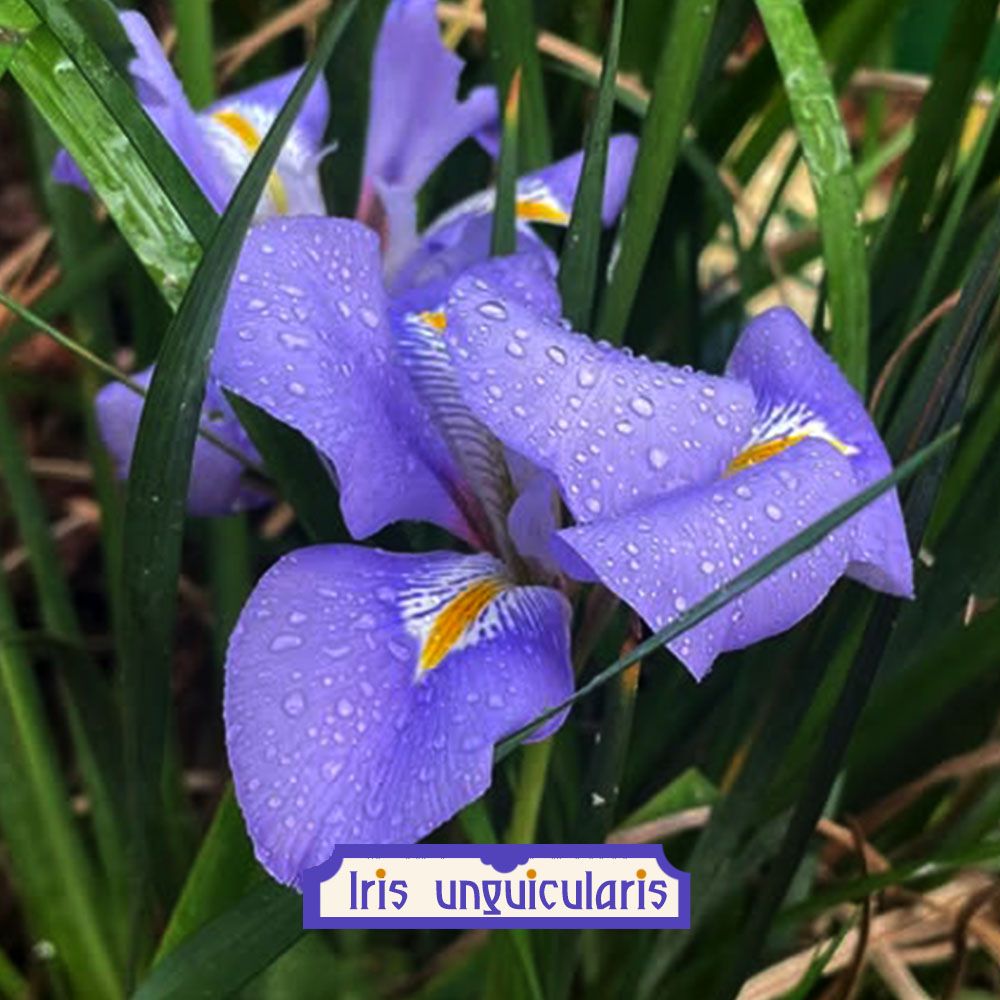
Iris unguicularis is a vigorous Mediterranean iris valued for its lilac-blue winter blooms and its remarkable drought tolerance.
The leaves are fine, leathery, upright leavesm forming a clump that remains evergreen in winter.
Its winter flowers are lilac-blue with a touch of yellow, slightly fragrant, rising delicately just above the foliage, bloom for several weeks.
Flowering occurs in winter and can begin as early as December, depending on the climate, more typically around February-March.
The Algerian Iris can withstand temperatures down to -15°C and requires a dry summer to flower well.
👨🌾GARDENING TIPS👨🌾: Iris unguicularis
-
- The Algerian Iris can be grown in full sun or partial shade, in any light, well-drained soil.
- In the Mediterranean region, it thrives in partial shade near large trees.
- In cooler regions, it should be planted in a sunny rockery.
- Water moderately; keep soil consistently moist but avoid waterlogging.
- Prune clumps every year / Divide every few years to maintain vigor and prevent overcrowding.
- The plant’s upright, clumping habit makes it suitable for borders, containers, and herb gardens – looks great with Helleborus argutifolius, Erodium pelargoniiflorum ‘Sweetheart, Ipheion uniflorum Alberto Castillo
- The Algerian Iris can be grown in full sun or partial shade, in any light, well-drained soil.
Learn more about gardening with the Algerian Iris:
The Tales & The Botany: Iris unguicularis
Iris unguicularis belongs to the family Iridaceae.
It is a botanical species endemic to the Mediterranean basin, ranging from Greece to Algeria, including western Syria and Turkey.
This xerophilous perennial (one that tolerates dry conditions) has a dense clumping habit of long, dark green leathery leaves.
It consists of long leaves measuring 50 to 60 cm, initially upright but later arching.
This iris has moderate growth, reaching a height of around 30 cm and gradually spreading over 50 cm or more through its thick rhizomes.
Myths and Traditions
Irises in general have long symbolized hope, wisdom, and courage.
In ancient Greece, the iris was associated with the goddess Iris, the messenger of the gods, who was believed to travel between heaven and earth on a rainbow.
Because Iris unguicularis blooms in winter, it has often been regarded in Mediterranean gardens as a symbol of perseverance and quiet resilience during the coldest months of the year.
In some regions, winter-flowering irises were traditionally planted near entrances or pathways as a sign of welcome and renewal.
Their unexpected blooms in midwinter were seen as a promise of the coming spring and a reminder of nature’s endurance.
Floral Morphology
The flowers of Iris unguicularis are solitary and emerge directly from the rhizome on very short stems.
Each flower is composed of six tepals arranged in two whorls.
The three outer tepals, known as falls, are broader and spatulate in shape, while the three inner tepals, known as standards, are narrower and held more upright.
The tepals are typically lilac to bluish-purple in color, with darker contrasting veins and a central yellow stripe or signal on the outer tepals.
The flowers measure approximately 5 to 8 centimeters in diameter and are slightly fragrant.
Each flower also bears three petaloid style branches that arch over the stamens, a characteristic feature of the iris genus.
Ecology
ris unguicularis is a xerophilous plant that is well adapted to dry, Mediterranean-type climates.
It thrives in full sun to partial shade and prefers light, well-drained soils, including rocky or sandy substrates.
The plant is naturally found on dry slopes, open woodlands, and scrublands around the Mediterranean basin.
Its evergreen, leathery foliage reduces water loss and allows the plant to remain photosynthetically active throughout the winter.
The dense clumps formed by its rhizomes help stabilize soil on slopes and contribute to erosion control in dry landscapes.
Reproductive Biology
Iris unguicularis reproduces both sexually by seed and vegetatively through its thick underground rhizomes.
Sexual reproduction occurs when pollinators, such as bees, visit the flowers and transfer pollen from the anthers to the stigmas.
After fertilization, the plant forms seed capsules containing several seeds, although seed production may be irregular in colder climates.
Vegetative reproduction occurs as the rhizomes slowly extend and produce new shoots, allowing the plant to form larger clumps over time.
This mode of reproduction ensures the long-term persistence of the plant in dry environments and enables gardeners to propagate it easily by division.
Other Names
Algerian Iris
Formerly Iris Stylosa
Origin
North Africa
Discover more from plant d'Avenir
Subscribe to get the latest posts sent to your email.
| Weight | 0,5 kg |
|---|---|
| Planting Season | September to November |
| Flower Color | 🔵 Blue |
| Flowering | January, February, March, December |
| Foliage | Persistent |
| Exposure | Full Sun |
| Frost Tolerance | -5°C to -10°C |
| Soil | Dry |
| Size | 0.3m H x 0.5m W |
Reviews
Only logged in customers who have purchased this product may leave a review.
You may also like…

Ipheion uniflorum Alberto Castillo
Spring starflower – spring flowers on a garlicky bush
Spring starflower – spring flowers on a garlicky bush
4,90 €


Erodium pelargoniiflorum ‘Sweetheart’
A cousin of geraniums with wondrous flowers.
A cousin of geraniums with wondrous flowers.
4,90 €


Hellebore argutifolius
Winter flowering perennial with marbled blue-green leaves
Winter flowering perennial with marbled blue-green leaves
4,90 €
Related Products


Euphorbia cyparissias Clarice Howard
A Euphorbia that resembles a soft little cyprus tree
A Euphorbia that resembles a soft little cyprus tree
4,90 €


Tradescantia Blushing Bride
Gorgeous blushes of pink and white that appear in the coldest nights.
Gorgeous blushes of pink and white that appear in the coldest nights.
Price range: 4,00 € through 8,00 €


Glechoma hederacea
A sweet smelling ground cover, producing little blue flowers all summer long.
A sweet smelling ground cover, producing little blue flowers all summer long.
4,00 €


Tanacetum densum subsp amani
A shrublet composed of soft, finely divided silvery gray-white leaves.
A shrublet composed of soft, finely divided silvery gray-white leaves.
Price range: 4,90 € through 12,00 €


Melissa officinalis
A perennial plant in the mint family that is adored by bees, royal families and tea drinkers.
A perennial plant in the mint family that is adored by bees, royal families and tea drinkers.
3,00 €


Cerastium tomentosum var. columnae
A grey-green spreading ground cover from the mountains.
A grey-green spreading ground cover from the mountains.
4,00 €


Artemisia Valerie Finnis
A semi-evergreen, aromatic variation on the theme of Artemisia.
A semi-evergreen, aromatic variation on the theme of Artemisia.
Price range: 4,00 € through 12,00 €


Erigeron kavinskianus
A daisy-like carpet of flowers
A daisy-like carpet of flowers
Price range: 4,90 € through 8,00 €


Mentha x piperita ‘Chartreuse’
A spicy mint, known for its use in the production of liqueurs and herbal teas.
A spicy mint, known for its use in the production of liqueurs and herbal teas.
4,90 €


Trachelospermum asiaticum ‘Ogon Nishiki’
Jasmine with colorful foliage and lovely white flowers in summer
Jasmine with colorful foliage and lovely white flowers in summer
4,90 €


Vinca minor
Looping elegance and ability to form a low flowering ground cover
Looping elegance and ability to form a low flowering ground cover
4,90 €


Satureja montana
A sweet smelling culinary herb from Europe
A sweet smelling culinary herb from Europe
4,90 €


Delosperma cooperi
A dwarf perennial known for its vermillion colored flowers
A dwarf perennial known for its vermillion colored flowers
4,90 €


Euphorbia myrsinites
Known for its draping form of silver-gray foliage and radiant blooms.
Known for its draping form of silver-gray foliage and radiant blooms.
4,90 €


Hieracium maculatum Leopard
A native perennial with blue-green leaves and a tall yellow flower
A native perennial with blue-green leaves and a tall yellow flower
3,00 €


Jacobaea maritima
A wooly white perennial plant from the Mediterranean region.
A wooly white perennial plant from the Mediterranean region.
4,90 €


Artemisia vulgaris Oriental Limelight
Striking green and yellow variegated foliage.
Striking green and yellow variegated foliage.
4,90 €
recent view product

Symphytum caucasicum
A striking groundcover perennial plant that produces cream-blue flowers all summer long
A striking groundcover perennial plant that produces cream-blue flowers all summer long
4,90 €

Leucanthemum vulgare
A bushy perennial that produces an explosion of white flowers
A bushy perennial that produces an explosion of white flowers
4,90 €

Thymus citriodorus
An upright Mediterranean shrub with delicious lemon scented leaves – ideal for salads and infusions.
An upright Mediterranean shrub with delicious lemon scented leaves – ideal for salads and infusions.
4,90 €

Collection de Vivaces pour 2m2
Collection de vivaces résilientes rose-lilas pour un jardin sec de 2m²
Collection de vivaces résilientes rose-lilas pour un jardin sec de 2m²
49,00 €

Iris unguicularis
A drought tolerant iris with lilac-blue flowers
A drought tolerant iris with lilac-blue flowers
7,50 €
There are no reviews yet.