
No products in the cart.
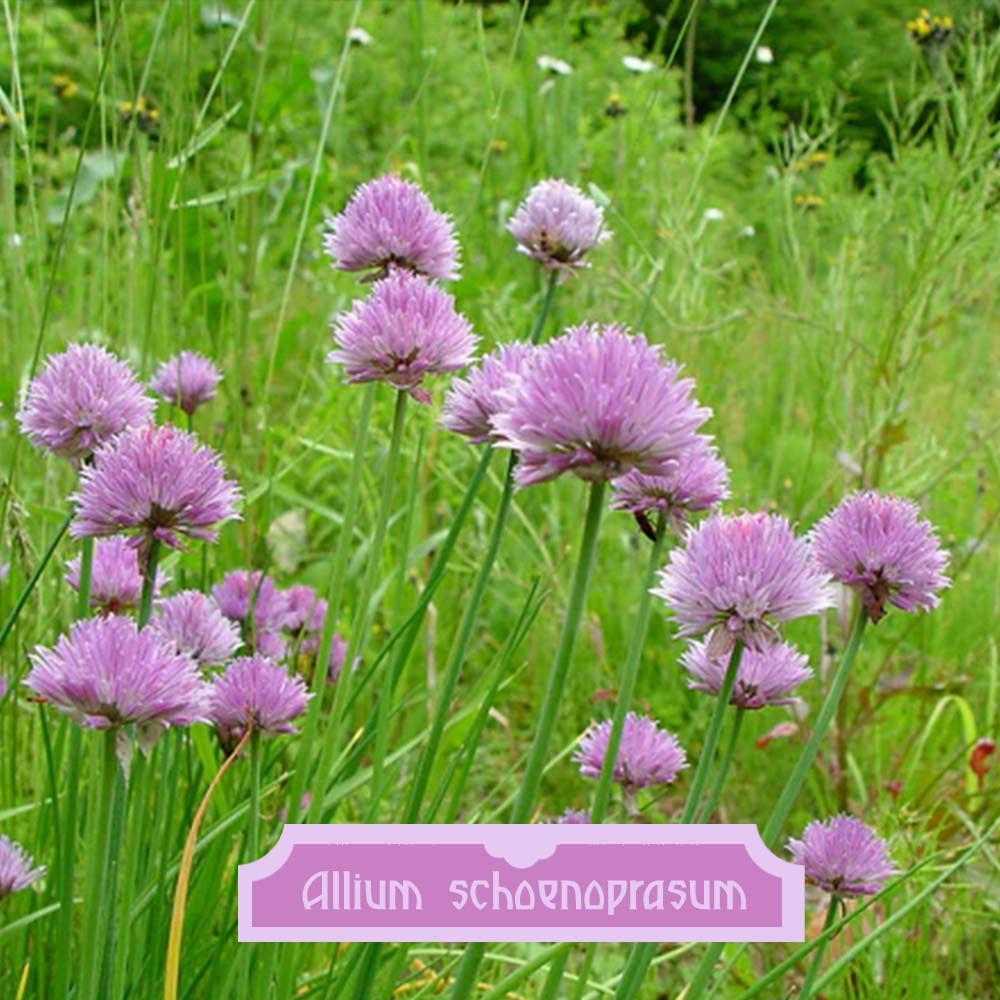

Allium schoenoprasum is a fragrant and culinary perennial herb, sought after for its resilience and for its ornamental uses.
The bulbs produce fine, tubular, blue-green leaves with a mild onion aroma and flavor, prized both for culinary use and ornamental appeal.
In late spring to early summer, chives produce upright, leafless stems topped with perfectly rounded umbels of star-shaped flowers in soft mauve to violet-purple.
The blooms rise above the foliage like small fireworks, adding structure and color to herb gardens and borders alike.
The leaves emit a mild garlic scent when crushed.
Chives grow in dense clumps formed by small, elongated bulbs.
It is both hardy and drought-tolerant in summer.
It is ideal for a wild gardens or xeriscaping, as a low border for instance, but it is also magnificent (and delicious) in a container in the city.
👨🌾GARDENING TIPS👨🌾: Allium schoenoprasum
-
- Chives thrive in full sun to partial shade and prefer well-drained, fertile soil, though they tolerate a variety of conditions.
- The plant is frost-tolerant and hardy in USDA zones 4–9.
- Water moderately; keep soil consistently moist but avoid waterlogging.
- Divide clumps every few years to maintain vigor and prevent overcrowding.
- The plant’s upright, clumping habit makes it suitable for borders, containers, and herb gardens – looks great with Artemisia camphorata, Carex buchananii, Geum coccineum ‘Carlkaer’
Learn more about gardening with chives:
👨🌾COOKING TIPS👨🌾
-
- The leaves, stems, and flower buds are all edible
- It will add a mild onion flavor to omelettes, fish, potatoes, soups and cream cheese toasties
- Add the flowers as an edible garnish!
- Regular harvesting of leaves encourages new growth and prolongs productivity.
Learn more about cooking with chives:
The Tales & The Botany: Allium schoenoprasum
Chives are the only species of Allium native to both the New and the Old Worlds.
Allium schoenoprasum, commonly known as chives or ciboulette, is a perennial herbaceous plant in the Amaryllidaceae family, closely related to onions, garlic, and leeks.
The genus Allium is ancient and widespread, its name derived from Latin and associated since antiquity with pungent, edible bulbs.
The species name schoenoprasum comes from Greek roots – σχοίνος, skhoínos (sedge or rush) and πράσον, práson (leek) – meaning “reed leek,” a reference to the plant’s slender, hollow leaves.
Its English name, chives, derives from the French word cive, from cepa, the Latin word for onion.
Romani have used chives in fortune telling – they would hang bunches of dried chives around a house to ward off disease and evil.
My favorite chives tale is that in the 19th century, Dutch farmers fed cattle on the herb to give a different taste to their milk. Today this weedy onion taste is considered unpleasant and is thrown away. It’s hard to imagine why…
Myths and Traditions
Chives have been cultivated for thousands of years across Europe and Asia, valued as much for their protective symbolism as for their flavor. In folklore, bunches of chives were hung in homes to ward off illness and evil spirits, and planted near dwellings to repel pests.
During the Middle Ages, Allium schoenoprasum was considered a strengthening herb, believed to support digestion and vitality. Its gentle nature distinguished it from stronger alliums, making it suitable for everyday use.
Today, chives embody a quiet duality: both ornamental and edible, humble yet essential, bridging the worlds of kitchen and garden with ease.
Floral Morphology
The inflorescence of Allium schoenoprasum is a compact, spherical umbel, typically 3–5 cm in diameter, composed of dozens of small, six-petaled flowers.
Each flower displays six violet-pink tepals, six protruding stamens tipped with pale anthers, and a central ovary. The blooms open sequentially, extending the flowering period over several weeks.
Rich in nectar and pollen, chive flowers are highly attractive to bees, butterflies, and other beneficial insects. The flowers are also edible, with a mild onion flavor and a decorative presence in salads and garnishes.
After flowering, the plant produces small black seeds contained within papery capsules, though it is most commonly propagated by division.
Ecology
In the wild, Allium schoenoprasum occurs across vast regions of Europe, Asia, and North America, growing in damp meadows, riverbanks, and open woodland edges.
It prefers full sun to light shade and thrives in moist, well-drained soils, though it tolerates a wide range of conditions and cold climates. Exceptionally hardy, chives survive harsh winters by retreating into their bulbs, resprouting vigorously in spring.
In garden ecosystems, chives play an important ecological role. Their flowers support pollinators, while their aromatic foliage is thought to deter certain pests, making them valuable companions in mixed plantings.
Resilient, generous, and quietly beautiful, Allium schoenoprasum remains one of the most enduring and beloved plants of both the ornamental and edible garden.
Reproductive Biology: Allium schoenoprasum
The plant reproduces via seeds and vegetative division.
Seeds germinate in spring, while division ensures rapid establishment and preserves the desired traits of cultivars.
Flowering typically occurs in the second or third year of growth, providing both aesthetic appeal and a food source for pollinators.
Other Names
Chives
Origin
North America/ Asia / Europe
Discover more from plant d'Avenir
Subscribe to get the latest posts sent to your email.
| Weight | 0,5 kg |
|---|---|
| Planting Season | March to May, September to November |
| Flower Color | 🩷 Pink |
| Flowering | May, June, July, August, September |
| Foliage | Deciduous |
| Exposure | Full Sun |
| Frost Tolerance | -20°C to -25°C |
| Soil | Cool, Moist, Dry, Well-Draining |
| Size | 0.3m H x 0.3m W |
Reviews
Only logged in customers who have purchased this product may leave a review.
You may also like…


Geum hybrid coccineum “Carlskaer”
Loved for its neon yellow petals and orange-yellow stamens
Loved for its neon yellow petals and orange-yellow stamens
4,90 €


Allium ampeloprasum var. ampeloprasum
A large bulb loved for its garlic flavoured leaves
A large bulb loved for its garlic flavoured leaves
4,90 €


Allium senescens subsp. montanum
Mountain garlic with pink pompom flowers
Mountain garlic with pink pompom flowers
4,90 €


Related Products


Delosperma cooperi
A dwarf perennial known for its vermillion colored flowers
A dwarf perennial known for its vermillion colored flowers
4,90 €


Erigeron kavinskianus
A daisy-like carpet of flowers
A daisy-like carpet of flowers
Price range: 4,90 € through 8,00 €


Melissa officinalis
A perennial plant in the mint family that is adored by bees, royal families and tea drinkers.
A perennial plant in the mint family that is adored by bees, royal families and tea drinkers.
3,00 €


Glechoma hederacea
A sweet smelling ground cover, producing little blue flowers all summer long.
A sweet smelling ground cover, producing little blue flowers all summer long.
4,00 €


Artemisia Valerie Finnis
A semi-evergreen, aromatic variation on the theme of Artemisia.
A semi-evergreen, aromatic variation on the theme of Artemisia.
Price range: 4,00 € through 12,00 €


Mentha x piperita ‘Chartreuse’
A spicy mint, known for its use in the production of liqueurs and herbal teas.
A spicy mint, known for its use in the production of liqueurs and herbal teas.
4,90 €


Artemisia vulgaris Oriental Limelight
Striking green and yellow variegated foliage.
Striking green and yellow variegated foliage.
4,90 €


Trachelospermum asiaticum ‘Ogon Nishiki’
Jasmine with colorful foliage and lovely white flowers in summer
Jasmine with colorful foliage and lovely white flowers in summer
4,90 €

Koeleria glauca Blue Sprite
An ornamental, low growing blue grass
An ornamental, low growing blue grass
Price range: 4,90 € through 12,00 €


Jacobaea maritima
A wooly white perennial plant from the Mediterranean region.
A wooly white perennial plant from the Mediterranean region.
4,90 €


Euphorbia myrsinites
Known for its draping form of silver-gray foliage and radiant blooms.
Known for its draping form of silver-gray foliage and radiant blooms.
4,90 €


Tanacetum densum subsp amani
A shrublet composed of soft, finely divided silvery gray-white leaves.
A shrublet composed of soft, finely divided silvery gray-white leaves.
Price range: 4,90 € through 12,00 €


Cerastium tomentosum var. columnae
A grey-green spreading ground cover from the mountains.
A grey-green spreading ground cover from the mountains.
4,00 €


Vinca minor
Looping elegance and ability to form a low flowering ground cover
Looping elegance and ability to form a low flowering ground cover
4,90 €


Satureja montana
A sweet smelling culinary herb from Europe
A sweet smelling culinary herb from Europe
4,90 €


Euphorbia cyparissias Clarice Howard
A Euphorbia that resembles a soft little cyprus tree
A Euphorbia that resembles a soft little cyprus tree
4,90 €


Tradescantia Blushing Bride
Gorgeous blushes of pink and white that appear in the coldest nights.
Gorgeous blushes of pink and white that appear in the coldest nights.
Price range: 4,00 € through 8,00 €
recent view product


Glechoma hederacea Variegata
A ground cover known for its fragrant, unusually variegated foliage
A ground cover known for its fragrant, unusually variegated foliage
4,90 €

Centaurea atropurpurea
A perennial thistle with intensely purplish-red flowers
A perennial thistle with intensely purplish-red flowers
Price range: 4,90 € through 16,00 €

Thymus citriodorus
An upright Mediterranean shrub with delicious lemon scented leaves – ideal for salads and infusions.
An upright Mediterranean shrub with delicious lemon scented leaves – ideal for salads and infusions.
4,90 €


Erodium pelargoniiflorum ‘Sweetheart’
A cousin of geraniums with wondrous flowers.
A cousin of geraniums with wondrous flowers.
4,90 €

Coreopsis verticillata ‘Zagreb’
A perennial coreopsis that forms a compact clump, covered with small golden-yellow flowers
A perennial coreopsis that forms a compact clump, covered with small golden-yellow flowers
4,90 €
There are no reviews yet.