
No products in the cart.
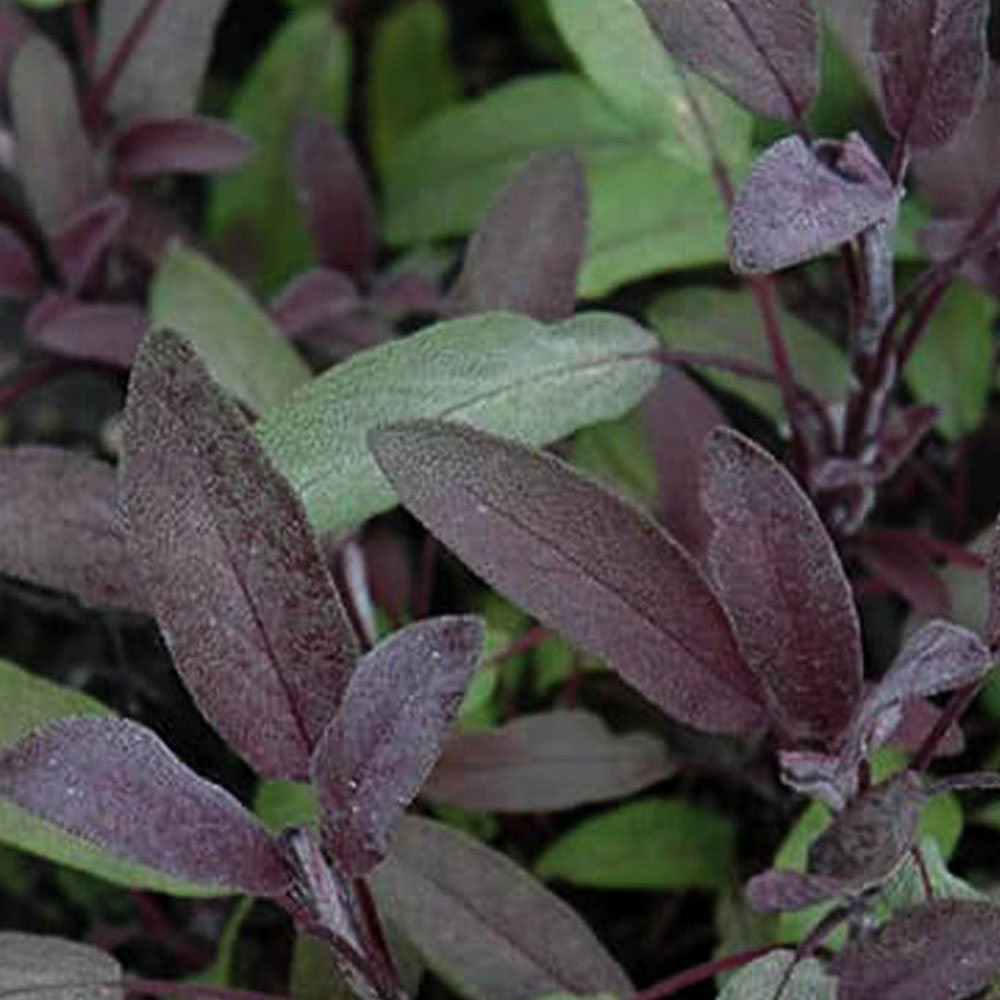


Salvia officinalis Purpurea, commonly known as purple sage, is a resilient sage, known for its striking purple foliage and aromatic properties.
The leaves are elongated, lance-shaped, and deeply veined with a purple to purplish-green color. They are slightly hairy and have a strong, pleasant aroma when crushed.
The flowers are small, tubular, and range from purple to lavender in color. They are arranged in spikes that rise above the foliage and bloom primarily in the late spring to early summer.
The Tale: Salvia officinalis Purpurea
The leaves of Salvia purpurea can be used to flavor meats, soups, and stews but they are not as commonly found in recipes as those of other sages.
Because it is so striking, it is more often used for fragrant-ornamental purposes.
The binary name, officinalis, refers to the plant’s medicinal use—the officina was the traditional storeroom of a monastery where herbs and medicines were stored.
Additionally, for those color enthusiasts out there – the color sage comes from the color of the foliage of the common (is she common though?) sage.
The sage is sage.
Treated as a holy herb by the Romans, planted in monasteries under Charlemagne before becoming an indispensable herb of great renown during the Middle Ages.
A soap, a soup, a cleansing herb for the house and the mind, a toothpaste, an infusion that wards off the plague… whatever you needed, salvia would bring you your salvation.
Other Names
Setcreasea pallida, purple secretia, purple-heart, or purple queen
Origin
Central America
Discover more from plant d'Avenir
Subscribe to get the latest posts sent to your email.
| Weight | 0,5 kg |
|---|---|
| Container Size | 9×9 cm, 2L |
| Flowering | April, May, June |
| Soil | Dry/Rocky |
| Exposure | Sun |
| Frost Tolerance | -15°C |
| Size | Height: 0.8 |
Reviews
Only logged in customers who have purchased this product may leave a review.
Related Products


Euphorbia myrsinites
Known for its draping form of silver-gray foliage and radiant blooms.
Known for its draping form of silver-gray foliage and radiant blooms.
4,90 €


Tanacetum densum subsp amani
A shrublet composed of soft, finely divided silvery gray-white leaves.
A shrublet composed of soft, finely divided silvery gray-white leaves.
Price range: 4,90 € through 12,00 €


Stachys byzantina
Silky white-grey leaves and tall striking flowers
Silky white-grey leaves and tall striking flowers
4,00 €


Echinacea purpurea
A perennial with purple flowers all summer long
A perennial with purple flowers all summer long
4,90 €


Glechoma hederacea
A sweet smelling ground cover, producing little blue flowers all summer long.
A sweet smelling ground cover, producing little blue flowers all summer long.
4,00 €


Potentilla anserina
A distinctly silvery, silky and lacy perennial.
A distinctly silvery, silky and lacy perennial.
4,90 €


Hellebore argutifolius
Winter flowering perennial with marbled blue-green leaves
Winter flowering perennial with marbled blue-green leaves
4,90 €


Erigeron kavinskianus
A daisy-like carpet of flowers
A daisy-like carpet of flowers
Price range: 4,90 € through 8,00 €


Vinca minor
Looping elegance and ability to form a low flowering ground cover
Looping elegance and ability to form a low flowering ground cover
4,90 €


Cerastium tomentosum var. columnae
A grey-green spreading ground cover from the mountains.
A grey-green spreading ground cover from the mountains.
4,00 €


Delosperma cooperi
A dwarf perennial known for its vermillion colored flowers
A dwarf perennial known for its vermillion colored flowers
4,90 €


Trachelospermum asiaticum ‘Ogon Nishiki’
Jasmine with colorful foliage and lovely white flowers in summer
Jasmine with colorful foliage and lovely white flowers in summer
4,90 €


Artemisia Valerie Finnis
A semi-evergreen, aromatic variation on the theme of Artemisia.
A semi-evergreen, aromatic variation on the theme of Artemisia.
Price range: 4,00 € through 12,00 €


Euphorbia cyparissias Clarice Howard
A Euphorbia that resembles a soft little cyprus tree
A Euphorbia that resembles a soft little cyprus tree
4,90 €


Tradescantia Blushing Bride
Gorgeous blushes of pink and white that appear in the coldest nights.
Gorgeous blushes of pink and white that appear in the coldest nights.
Price range: 4,00 € through 8,00 €


Melissa officinalis
A perennial plant in the mint family that is adored by bees, royal families and tea drinkers.
A perennial plant in the mint family that is adored by bees, royal families and tea drinkers.
3,00 €


Mentha x piperita ‘Chartreuse’
A spicy mint, known for its use in the production of liqueurs and herbal teas.
A spicy mint, known for its use in the production of liqueurs and herbal teas.
4,90 €
recent view product


Sedum “Weihenstephaner Gold”
A low-growing sedum with a thick, dependable dark-bronze/green foliage and prolific flowering cycle.
A low-growing sedum with a thick, dependable dark-bronze/green foliage and prolific flowering cycle.
4,90 €


Lavandula angustifolia
A highly aromatic, flowering perennial used for cooking in many cultures
A highly aromatic, flowering perennial used for cooking in many cultures
Price range: 4,90 € through 12,00 €


Artemisia absinthium
A highly fragrant, medicinal and striking grey-green bush with yellow flowers.
A highly fragrant, medicinal and striking grey-green bush with yellow flowers.
4,90 €

Liriope muscari ‘Big Blue’
A perennial with evergreen grass-like leaves and tall spikes of lilac flowers in the fall
A perennial with evergreen grass-like leaves and tall spikes of lilac flowers in the fall
4,90 €
There are no reviews yet.