
No products in the cart.
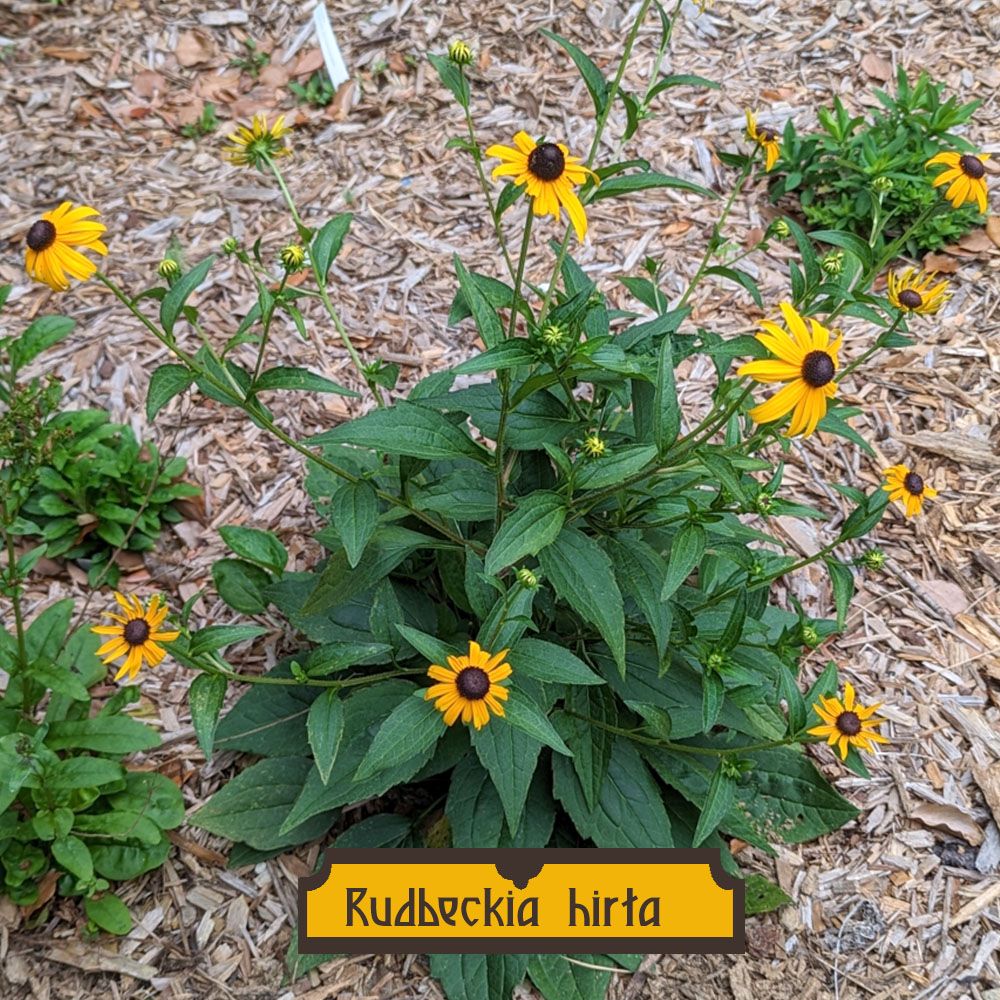

Rudbeckia hirta is a short-lived perennial that produces hundreds of butter yellow, daisy-like flowers in a single season.
The petals are butter yellow and oval shaped.
The leaves are oval and pointed, slightly serrated along the edges, and appear in basal tufts.
The stem leaves are smaller and sessile (without petioles), with a rounded, cordate base; their color is a bright, light green.
The flowers are quite large, attracting both butterflies and passerbys to your garden.
While Rudbeckia hirta is a short-lived perennial (1-2 years), it will easily reseed itself.
Hailing from North America, it has become a staple of dry gardens across Europe, acclimating itself without becoming invasive and supporting numerous pollinators across a variety of climates.
👨🌾 GARDENING TIPS👨🌾: Rudbeckia hirta
-
- Easy to grow as an annual, this short-lived perennial quickly forms a medium-sized clump that readily self-seeds.
- It prefers full sun and is content with ordinary, fairly fertile soil, which is fresh to occasionally dry.
- Looks great with Achillea ptarmica Boule de Neige, Helenium ‘Rubinzwerg’, Achillea Coronation Gold, Nepeta x faassenii
Learn more about gardening with the Rudbeckia family:
Discover other varieties of Rudbeckia: The Lesser Known Varieties
The Tales & The Botany: Rudbeckia hirta
In the wild in the US, this plant grows in prairies, pastures, and cultivated fields, where it is considered a weed. Except in Maryland, where it is the state flower.
The genus name honors Olof Rudbeck (1630-1702) Swedish botanist and founder of the Uppsala Botanic Garden in Sweden where Carl Linnaeus was once a professor of botany.
The species name of hirta means “hairy”, a reference to the short bristles that cover the leaves and stems.
It is toxic when ingested by cats, but was used medicinally by Native Americans.
🎨 All Rudbeckia species are dye plants (especially R. hirta and R. laciniata) due to the presence of flavonols in their tissues. The inflorescences alone produce yellow-orange colors, while the entire plant gives yellow-green hues.
🌸 Floral Morphology : Rudbeckia hirta
The plant itself is a herbaceous perennial, though in many climates it behaves like a short-lived perennial or even an annual.
Its stems are hairy and upright, supporting the flower heads in a way that maximizes visibility to pollinators, while its rough, lance-shaped leaves are adapted to conserve moisture and deter herbivory.
The floral collar is divided into two concentric zones of different colors, a bright yellow border surrounding a central orange-yellow zone.
Interestingly, the hairs on the leaves and stems can also reflect light, slightly reducing leaf temperature and helping the plant survive in open, sunny prairies.
🌱 Reproductive Biology
From a reproductive standpoint, Rudbeckia hirta is prolific. The plant produces small, dry fruits called achenes, which often self-seed around the parent plant.
This self-seeding habit, combined with its long blooming period from mid-summer to early fall, makes ‘Prairie Sun’ particularly resilient in gardens and wildflower plantings.
Its bright yellow flowers are highly attractive to bees, butterflies, and even some birds, highlighting its ecological role beyond simple ornamentation.
🌍 Ecology & Adaptations
Native to the prairies and open fields of North America, where it thrives in well-drained soils, including dry, sandy, or rocky sites.
It prefers full sun and tolerates moderate drought, although heavy or waterlogged soils are less suitable.
Although it is a short-lived perennial, typically lasting one to two years, it readily self-seeds, allowing it to persist in gardens and wildflower meadows.
Its bright flowers, which bloom from midsummer through early autumn, attract a wide variety of pollinators, including bees and butterflies, while its seeds provide food for birds and small mammals.
Naturalized in Europe, Rudbeckia hirta grows easily in temperate climates without becoming invasive, making it a common feature in dry gardens, roadside verges, and meadow plantings. B
y providing extended nectar and pollen resources, supporting wildlife, and improving soil structure with its fibrous roots, it contributes significantly to local biodiversity and ecological resilience.
Other Names:
Black eyed Susan
Yellow coneflower
Origin:
North America
Discover more from plant d'Avenir
Subscribe to get the latest posts sent to your email.
| Weight | 0,5 kg |
|---|---|
| Flowering | July, August, September, October |
| Exposure | Full Sun |
| Frost Tolerance | -25°C to -30°C |
| Soil | Any, Dry, Sandy |
| Size | 0.8m H x 0.4m W |
Reviews
Only logged in customers who have purchased this product may leave a review.
You may also like…


Helenium Rubinzwerg
A perennial with fire colored flowers all summer long
A perennial with fire colored flowers all summer long
4,90 €


Achillea ptarmica Boule de Neige
White pompom flowers to attract bees to your garden all summer long.
White pompom flowers to attract bees to your garden all summer long.
Price range: 4,90 € through 8,00 €


Nepeta x faassenii
Catnip is known for its grey-green, aromatic foliage and masses of lavender blue flowers.
Catnip is known for its grey-green, aromatic foliage and masses of lavender blue flowers.
4,90 €


Achillea filipendulina Coronation Gold
A tall flowering perennial known for its bright yellow flowers and long flowering season.
A tall flowering perennial known for its bright yellow flowers and long flowering season.
4,90 €
Related Products


Euphorbia myrsinites
Known for its draping form of silver-gray foliage and radiant blooms.
Known for its draping form of silver-gray foliage and radiant blooms.
4,90 €


Hellebore argutifolius
Winter flowering perennial with marbled blue-green leaves
Winter flowering perennial with marbled blue-green leaves
4,90 €


Erigeron kavinskianus
A daisy-like carpet of flowers
A daisy-like carpet of flowers
Price range: 4,90 € through 8,00 €


Cerastium tomentosum var. columnae
A grey-green spreading ground cover from the mountains.
A grey-green spreading ground cover from the mountains.
4,00 €


Echinacea purpurea
A perennial with purple flowers all summer long
A perennial with purple flowers all summer long
4,90 €


Hieracium maculatum Leopard
A native perennial with blue-green leaves and a tall yellow flower
A native perennial with blue-green leaves and a tall yellow flower
3,00 €


Euphorbia cyparissias Clarice Howard
A Euphorbia that resembles a soft little cyprus tree
A Euphorbia that resembles a soft little cyprus tree
4,90 €


Trachelospermum asiaticum ‘Ogon Nishiki’
Jasmine with colorful foliage and lovely white flowers in summer
Jasmine with colorful foliage and lovely white flowers in summer
4,90 €


Melissa officinalis
A perennial plant in the mint family that is adored by bees, royal families and tea drinkers.
A perennial plant in the mint family that is adored by bees, royal families and tea drinkers.
3,00 €


Artemisia Valerie Finnis
A semi-evergreen, aromatic variation on the theme of Artemisia.
A semi-evergreen, aromatic variation on the theme of Artemisia.
Price range: 4,00 € through 12,00 €


Stachys byzantina
Silky white-grey leaves and tall striking flowers
Silky white-grey leaves and tall striking flowers
4,00 €


Mentha x piperita ‘Chartreuse’
A spicy mint, known for its use in the production of liqueurs and herbal teas.
A spicy mint, known for its use in the production of liqueurs and herbal teas.
4,90 €


Tanacetum densum subsp amani
A shrublet composed of soft, finely divided silvery gray-white leaves.
A shrublet composed of soft, finely divided silvery gray-white leaves.
Price range: 4,90 € through 12,00 €


Potentilla anserina
A distinctly silvery, silky and lacy perennial.
A distinctly silvery, silky and lacy perennial.
4,90 €


Glechoma hederacea
A sweet smelling ground cover, producing little blue flowers all summer long.
A sweet smelling ground cover, producing little blue flowers all summer long.
4,00 €


Delosperma cooperi
A dwarf perennial known for its vermillion colored flowers
A dwarf perennial known for its vermillion colored flowers
4,90 €


Vinca minor
Looping elegance and ability to form a low flowering ground cover
Looping elegance and ability to form a low flowering ground cover
4,90 €
recent view product


Calendula officinalis
A glorious medicinal and tinctorial herb.
A glorious medicinal and tinctorial herb.
4,90 €


Jacobaea maritima
A wooly white perennial plant from the Mediterranean region.
A wooly white perennial plant from the Mediterranean region.
4,90 €

Houttuynia cordata ‘Chameleon’
A fragrant and ornamental perennial with color-shifting foliage
A fragrant and ornamental perennial with color-shifting foliage
6,00 €


Artemisia absinthium
A highly fragrant, medicinal and striking grey-green bush with yellow flowers.
A highly fragrant, medicinal and striking grey-green bush with yellow flowers.
4,90 €
Hellebore argutifolius
Winter flowering perennial with marbled blue-green leaves
Winter flowering perennial with marbled blue-green leaves
4,90 €
There are no reviews yet.