
No products in the cart.
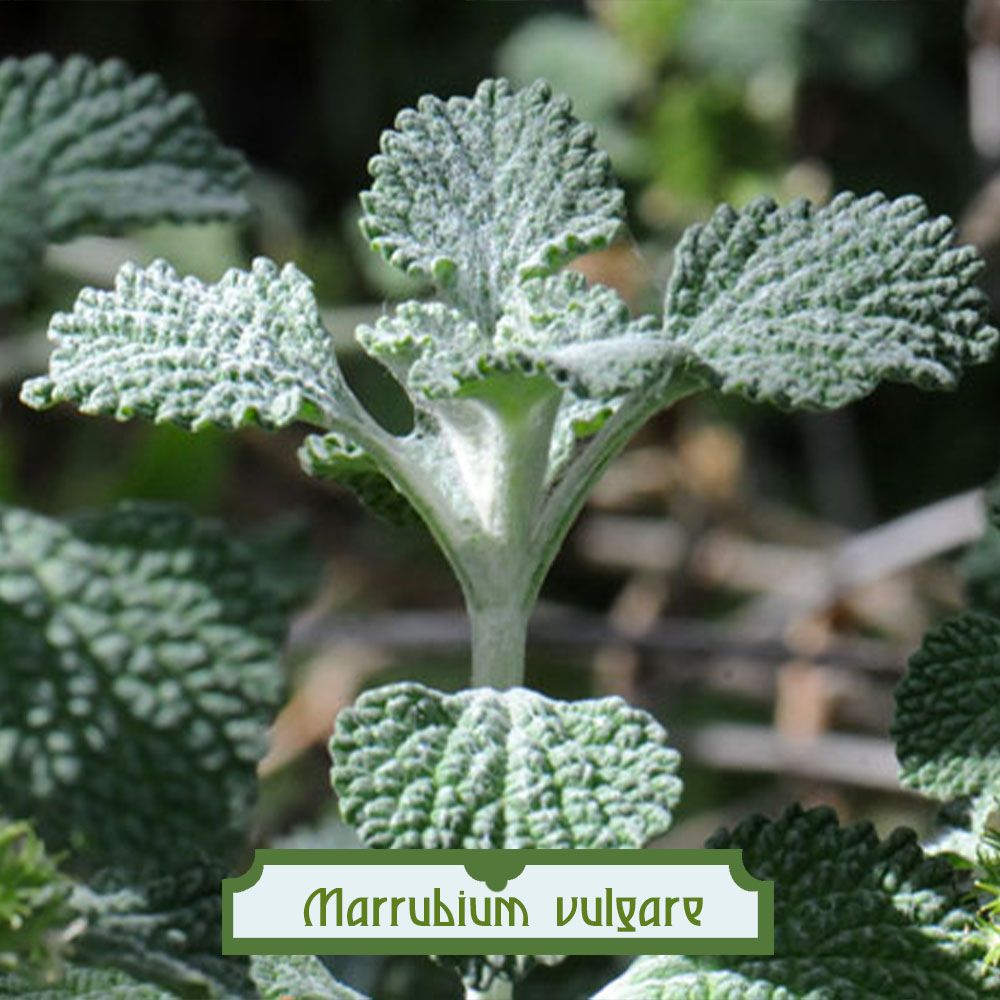

A perennial flowering herb with medicinal properties
Marrubium vulgare is a tender drought hardy perennial and a member of the mint family, used historically for making candies, syrups and teas.
The flowers are small and white, borne in clusters.
The leaves are grey, with a densely crinkled surface, covered in fine white hairs and fragrant.
The foliage resembles that of mint, while its scent slightly evokes thyme. The fragrance is strongest when the leaves are fresh, diminishing as the leaves dry.
👨🌾GARDENING TIPS👨🌾: Marrubium vulgare
Learn more about gardening with White Horehound:
👩🍳COOKING TIPS👩🍳: Marrubium vulgare
The Oxford English Dictionary derives the word horehound from Old English hoar (furry, as in “hoarfrost”) and hune (a word of unknown origin designating a class of herbs or plants).
The word “white” is generally used in botanical contexts, to distinguish it from black horehound (Ballota nigra), a similar-looking herb.
The Latin name Marrubium derives from the Hebrew word marrob, meaning bitter juice, while vulgare means ‘common’ or ‘well known’.
White horehound has been mentioned in conjunction with use as a folk medicine dating at least back to the 1st century BC, where it appeared as a remedy for respiratory ailments in the treatise De Medicina by Roman encyclopaedist Aulus Cornelius Celsus.
It is one of the ingredients of the Ricola throat lozenge.
Gnerally, it is used today more as a food or flavoring additive rather than a specific cure.
Marrubium vulgare is a herbaceous perennial of the Lamiaceae (mint) family.
Its flowers are small, tubular, and bilabiate (two-lipped), typically whitish to pale pink, arranged in dense, globular axillary clusters along the upper stems.
Each flower has a calyx of five fused sepals and a corolla with a pronounced upper and lower lip, adapted for insect pollination.
The flowers are hermaphroditic, with four stamens (two long, two short) and a single style that protrudes slightly.
Flowering occurs mainly from late spring to early summer, and the inflorescences are subtended by small, woolly bracts.
Marrubium vulgare reproduces both sexually and vegetatively.
Sexual reproduction occurs via seed (achenes), which are small, hard, and capable of dispersal by wind or animals.
The seeds germinate readily under suitable conditions.
Vegetative reproduction is possible through root and stem fragments, allowing the plant to form clonal patches.
Marrubium vulgare is primarily pollinated by bees and other nectar-collecting insects, and its flowers produce nectar to attract pollinators.
The species is self-fertile but benefits from cross-pollination to increase seed viability.
Marrubium vulgare is also used as a natural grasshopper repellent in agriculture.
It can grow in poor soils and is very drought tolerant.
Its dense, woolly foliage reduces water loss, making it well adapted to semi-arid conditions.
The flowers attract a wide range of pollinators, particularly bees and butterflies, providing an important nectar source.
The plant’s vigorous growth and ability to self-seed allow it to form extensive patches, which can stabilize soil in degraded areas but also make it moderately invasive in some habitats.
Introduced to Australia and New Zealand in the 19th century as a medicinal herb, it quickly became invasive.
As livestock consider it unpalatable, it can quickly take over fields and marshes.
White horehound
Europe
Subscribe to get the latest posts sent to your email.
| Weight | 0,5 kg |
|---|---|
| Flower Color | ⚪ White |
| Flowering | May, June, July |
| Soil | Any |
| Exposure | Full Sun |
| Frost Tolerance | -15°C to -20°C |
| Size | 0.3m H x 0.5m W |
Only logged in customers who have purchased this product may leave a review.


A luminous bush covered in white daisy flowers all summer long
A luminous bush covered in white daisy flowers all summer long


A perennial flowering plant that produces sweetly scented pink or white flowers all summer long.
A perennial flowering plant that produces sweetly scented pink or white flowers all summer long.


A popular light, green and white groundcover.
A popular light, green and white groundcover.


A highly fragrant, grey-green bush.
A highly fragrant, grey-green bush.


A highly fragrant, medicinal and striking grey-green bush.
A highly fragrant, medicinal and striking grey-green bush.


A species of flowering plant in the stonecrop family – drought tolerant, with vibrant pink flowers and a spectacularly long flowering period.
A species of flowering plant in the stonecrop family – drought tolerant, with vibrant pink flowers and a spectacularly long flowering period.


An evergrey, fragrant perennial that will bring a distinctly Mediterranean atmosphere.
An evergrey, fragrant perennial that will bring a distinctly Mediterranean atmosphere.


A grey-green spreading ground cover from the mountains.
A grey-green spreading ground cover from the mountains.


Known for its draping form of silver-gray foliage and radiant blooms.
Known for its draping form of silver-gray foliage and radiant blooms.


A distinctly silvery, silky and lacy perennial.
A distinctly silvery, silky and lacy perennial.


A highly aromatic, flowering perennial used for cooking in many cultures
A highly aromatic, flowering perennial used for cooking in many cultures


Silky white-grey leaves and tall striking flowers
Silky white-grey leaves and tall striking flowers

An ornamental, low growing blue grass
An ornamental, low growing blue grass


A fragrant herb used in many cultures for cooking and deserts.
A fragrant herb used in many cultures for cooking and deserts.


A perennial with soft, ash gray foliage and yellow button flowers
A perennial with soft, ash gray foliage and yellow button flowers


A deciduous perennial with fleshy, blue-grey-green leaves that naturally thrives on the wind and sea swept coasts
A deciduous perennial with fleshy, blue-grey-green leaves that naturally thrives on the wind and sea swept coasts


Catnip is known for its grey-green, aromatic foliage and masses of lavender blue flowers.
Catnip is known for its grey-green, aromatic foliage and masses of lavender blue flowers.


A wooly white perennial plant from the Mediterranean region.
A wooly white perennial plant from the Mediterranean region.


A shrublet composed of soft, finely divided silvery gray-white leaves.
A shrublet composed of soft, finely divided silvery gray-white leaves.


A semi-evergreen, aromatic variation on the theme of Artemisia.
A semi-evergreen, aromatic variation on the theme of Artemisia.


A highly fragrant, beautifully silver-grey bush with soft leaves and yellow flowers.
A highly fragrant, beautifully silver-grey bush with soft leaves and yellow flowers.

A bright yellow medicinal and fragrant perennial herb
A bright yellow medicinal and fragrant perennial herb

Soft grey ground cover with small white flowers.
Soft grey ground cover with small white flowers.

Lilac-metallic flowers on tall spires
Lilac-metallic flowers on tall spires


An unusually soft, grey flowering plant from the mint family.
An unusually soft, grey flowering plant from the mint family.
There are no reviews yet.