
No products in the cart.
Competition and Planting Information
Let’s try to understand what we are talking about when we talk about plant strategies or plant systems – the organisation of large scale or small scale group planting patterns – and see if we can improve the way the ‘Planting Information’ is presented on each and every plant in the world.
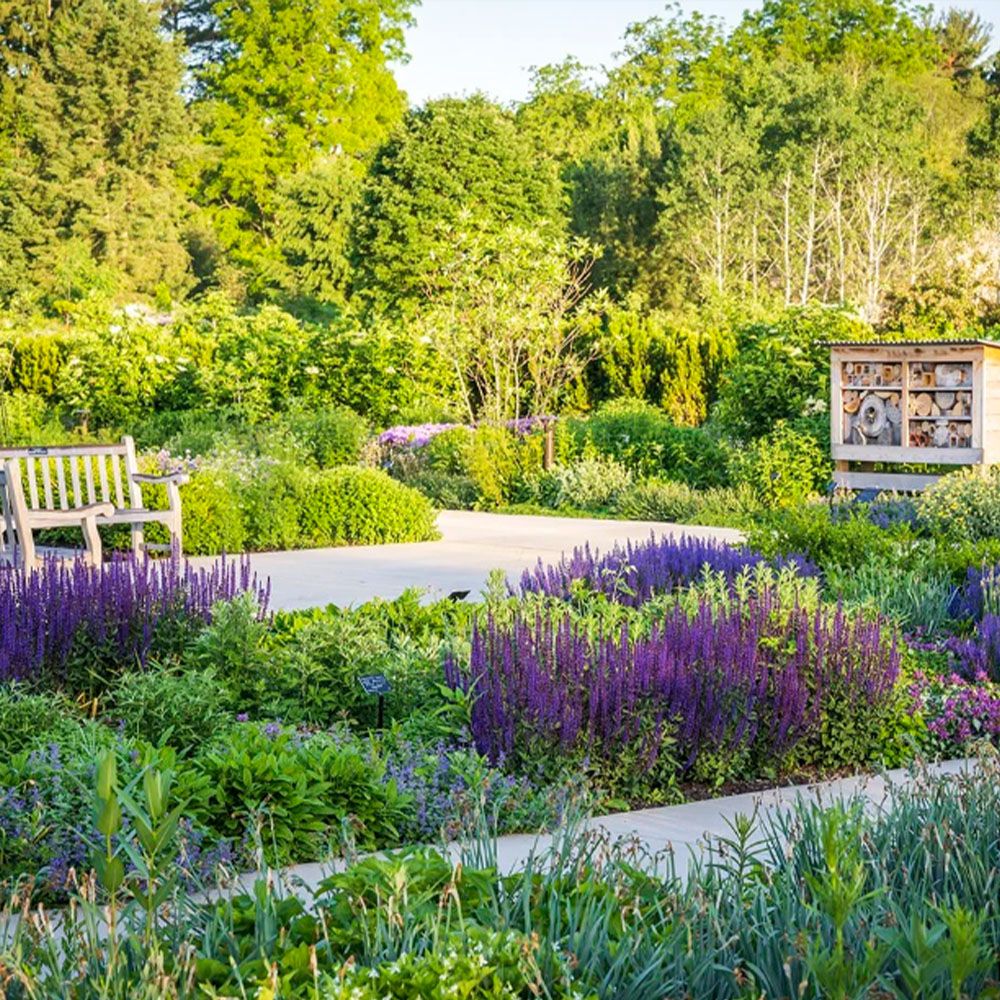
We’ll break it down into a few sections – how different plants evolved different skills to survive, how to understand sociability and competition within a group, their specific strengths and weaknesses and, finally, a proposition for a way to see this right from the label! The last part is a work in progress, based on a thought and idea collaboration with Thomas Rainer on how to better inform gardeners on what each plant needs and how each plant flourishes. The photo at the head of this post is from the incredible work he did with his company, Phyto Studio and Didier Design Studio, on the Arboretum at Penn State – natural, dynamic, eternal… Read more about the project here.
Because the more you notice how each is different, the more you will see what each requires and what each is good at. A lavender will not creep, not will a thyme climb – understanding the reasons behind these evolutions and adaptations allows us to arrange a space to better accommodate the plants (and help them flourish!), rather than trying to plant them blindly in an ill suited space next to ill suited neighbors and hope for the best.
As we go forward, it’s important to remember that everything changed and changes for a reason and trying to see beyond the adaptations, to see the initial reason for the shift, is what we try to do when we observe a plant. What was it that they needed? That didn’t work for them? That they preferred? That they disliked? So many questions, so let’s begin our journey…
“Intelligence is the ability to adapt to change.”
― Stephen Hawking
Alright so
Plant Strategies : CSR Theory
The Universal Adaptive Strategy Theory or the CSR Theory is an evolutionary theory developed by J. Philip Grime in collaboration with Simon Pierce. It is the understanding that plants’ response to a site depends on differences in stress and disturbance. What are we qualifying as stress and how is that different from disturbance?
Stress
This includes any type of external factors that reduce growth and reproduction – limited light, limited water, poor soil, limited nutrients, and varying temperatures.
Disturbance
This is the partial or complete destruction of the plant due to people, disease, animals, or weather events (wind damage, drought, fire, erosion, grazing, construction, etc).


The CSR triangle then places plants into three categories based on their tolerance to stress and disturbance, and they are then classified as competitors, stress-tolerators, and ruderals (CSR).
Let’s break these guys down now.
- C = Competitive.
- perennials that tend to take over where there is little stress or disturbance. They spread and often form large clumps, and they thrive by hogging resources. Competitors tend to occupy a mature garden.
- Botanically: Thrive in areas of low intensity stress (moisture deficit) and disturbance and excel in biological competition
- Example: Trees, Angelica archangelica , Ficus insipida, Achillea
- S = Stress-tolerant
- Survival adaptations for stressful, variable, or deteriorating site conditions like inconsistent light or water availability. They can fill in where competitors can’t survive and are typically perennials. They thrive in high stress, low disturbance sites and tend to be slow-growers since resource use is conserved and directed towards establishing a few mature plants in a constrained environment.
- Botanically: individual survival via maintenance of metabolic performance in variable and unproductive niches
- Example: Thymus, Hylotelephium, Crassulaceae
- R = Ruderal ( these are the species that colonize disturbed lands)
- Easy Mode: Short lifespans and are typically annual or biennial species. They thrive in low stress, high disturbance sites and are known to rapidly produce and spread seed. Ruderals quickly begin again from dispersed seed. These plants tend to dominate a plant community in its early stages after a large disturbance. Over time the garden will move towards stress-tolerator and competitor plants.
- Botanically: rapid gene propagation via rapid completion of the lifecycle and regeneration in niches where events are frequently lethal to the individual.
- Example: Annuals like Nigella, Asteraceae
Plant Strategies : Strengths and Weaknesses
Across evolutionary time, these optimizations reflect different solutions to the same fundamental problem: how to acquire energy, water, and space while reproducing successfully.
Competitors invest in dominance, stress-tolerators invest in endurance, and ruderals invest in opportunity. Each strategy excels under certain conditions and fails under others, ensuring that no single type can dominate all environments indefinitely.
Instead, natural ecosystems are shaped by shifting balances between these strengths and weaknesses, producing the layered, dynamic plant communities observed in forests, grasslands, deserts, and wetlands.
Identifying the strengths and weaknesses of each family/species involves observation and patience – changing climates also means that what was true ten years ago, or even two years ago, may no longer be true this year. So remaining attentive to the reactions of the plants to the temperature, to the changes in the soil, in the number of pollinators will help us understand what is happening to the ecosystem writ large. Speaking of which, let’s talk about soil!
Plant Strategies: SOIL


Identifying your type of soil will be crucial to understanding what type of plants will survive in your area. How to do this? There is a basic jar experiment that you can do at home – take a handful of soil from your garden (taking multiple will improve your chances of understanding what is actually going on, writing down where you took your sample on each glass jar), pour water over the soil and let it sit for 24 hours.
You should see the layers begin to emerge in that time – sand on the bottom, silt in the middle, clay on the top. The thickness of the layers will give you an approximation of the proportions. Obviously if you need a precise understanding, there are laboratories in every region to which you can send your samples. In France there are 24 across the country and the closest one to us is in Limoges.
Bottom: Sand particles are the largest. Soils with high sand content feel gritty and loose. They drain quickly, warm up fast, and are easy for roots to penetrate. Because water moves through them rapidly, they tend to dry out easily and hold fewer nutrients. Sandy soils favor plants that are drought-tolerant, fast-rooting, or adapted to low fertility, such as many Mediterranean, desert, and pioneer species.
Middle: Silt particles are medium-sized. Silty soils feel smooth and silky when wet. They hold more water and nutrients than sand but still allow reasonable drainage. They are often very fertile and support productive plant growth. However, they can compact easily and erode if left bare. Many agricultural and floodplain soils are rich in silt, which is why these areas are naturally productive.
Top: Clay particles are the smallest. Clay soils feel sticky when wet and hard when dry. They hold large amounts of water and nutrients because of their enormous surface area and electrical charge. This makes them potentially very fertile, but also difficult for roots and air to penetrate. Drainage is slow, and waterlogging is common. Plants growing in clay soils must tolerate poor aeration and periodic saturation, or develop strong, penetrating root systems. Mediterranean plants HATE clay for instance.
Ecologically, this triangle helps explain why different plant communities form in different places.
- Sandy soils tend to support stress-tolerant and pioneer species.
- Clay soils favor plants adapted to heavy, moist, and nutrient-rich conditions.
- Silty and loamy soils often support highly competitive vegetation, including forests and productive grasslands.
Planting Information: Festuca glauca
We’ve done a test to see if we can integrate all this information into one product sheet because it’s a lot to keep in your head when you’re just popping into your local nursery. Here it is:


Is this useful? Would you like to see this type of information on all of our perennials? Is this irrelevant and unhelpful? We’d like to hear all of your feedback, your thoughts and proposals because it’s your opinion that matters most!
Please let us know in the comments below or send us an email with all of your ideas. We really believe that there is a better way to describe a plant’s behavior than the standard soil/exposure/size description and perhaps integrating different evolutionary notions into the plant information might facilitate the choice for you as gardeners/verdant balcony makers/greendoor space creators?
Discover more from plant d'Avenir
Subscribe to get the latest posts sent to your email.